Posts

CrPC Section 133: Power to Remove Public Nuisance

Image
Section 133 to 143 of CRPC specifically deals with the Removal of any existing Nuisance in the Public place.  It is one of the most powerful tools in the hands of common public for removal of the danger arising or hanging on their heads, due to such nuisance. Lack of awareness about this law & its technicalities have resulted into less utilization of this powerful constitutional method for common benefit. Today we shall discuss the basic framework of this law. *** An application can be made under this section to a District Magistrate for the removal of a public nuisance.  Once application is received from the petitioner, magistrate orders a preliminary inquiry.  After satisfying himself with the initial material of the case through preliminary inquiry, and if required, after taking evidence on oath, magistrate issues an Order (an Order of Conditional in nature) (also known as Conditional Order) directing the opposite party to either remove such obstruction...

'Standing Committees' of Lok Sabha in India

Image
Twenty Four (24) 'Department Related Standing committees (DRSCs)' of Loksabha In 1993, in the history of Indian democracy a major initiative was taken in the direction of making the Parliament more effective in exercising control over and giving direction to the functioning Government (i.e.the executive) and thereby making the executive more accountable. Parliamentary Standing Committee means a Committee which is appointed or elected by the House or nominated by the Speaker and which works under the direction of the Speaker and presents its report to the House. Parliamentary Committees are of two kinds: Standing Committees and Ad hoc Committees. The Financial Committees, Department Related (DRSCs), and some other Committees come under the category of "Standing Committees".  "Ad hoc Committees" are appointed for a specific purpose and they cease to exist when they finish the task assigned to them and submit a report. *** Each Department Related St...

15 Animal Rights Every Animal Lovers in India Must Know

Image
1. Article 51 A (g): It is the fundamental right of every citizen of India to have compassion for all living creatures. 2. IPC Sections 428 and 429:  To kill or maim any animal, including stray animals is a punishable offence. 3. Section 11 (1)(i) and Section 11 (1)(j), Prevention of Cruelty to Animals Act, 1960: Abandoning any animal for any reason can land you in prison for up to three months. 4. Rule 3, Prevention of Cruelty to Animals (Slaughterhouse) Rules, 2001; Chapter 4, Food Safety and Standards Regulations, 2011: No animal (including chickens) can be slaughtered in any place other than a slaughterhouse. Sick or pregnant animals shall not be slaughtered. 5. ABC Rules, 2001: Stray dogs that have been operated for birth control cannot be captured or relocated by anybody including any authority. 6. Section 11 (1)(h), Prevention of Cruelty to Animals Act, 1960: Neglecting an animal by denying her sufficient food, water, shelter, and exercise or by keeping him chain...

Customer Protection – Limiting Liability of Customers in Unauthorised Electronic Banking Transactions

Image
Unauthorised or fraudulent electronic banking transaction in your account? Do not panic.  Follow the steps outlined by the RBI in the following notification. "Customer Protection – Limiting Liability of Customers in Unauthorised Electronic Banking Transactions" The Reserve bank of India (RBI) on 6th July 2017 amid the national drive toward digital transactions and rising incidents of fraud, had notified the norms in order to fix the liability in cases if a person loses money through an unauthorized electronic banking transaction like cyber attack on the bank or hacking of account. Read RBI notification here: DBR.No.Leg.BC.78/09.07.005/2017-18 https://www.google.com/url?sa=t&source=web&rct=j&url=https://rbidocs.rbi.org.in/rdocs/notification/PDFs/NOTI15D620D2C4D2CA4A33AABC928CA6204B19.PDF&ved=2ahUKEwjUk-OM0bDwAhVtzzgGHTjoAVEQFjADegQIFxAC&usg=AOvVaw088s3dB_PYeb4Ki8CujJ67&cshid=1620152507485 *** Disclaimer: These guides are not legal advice, no...

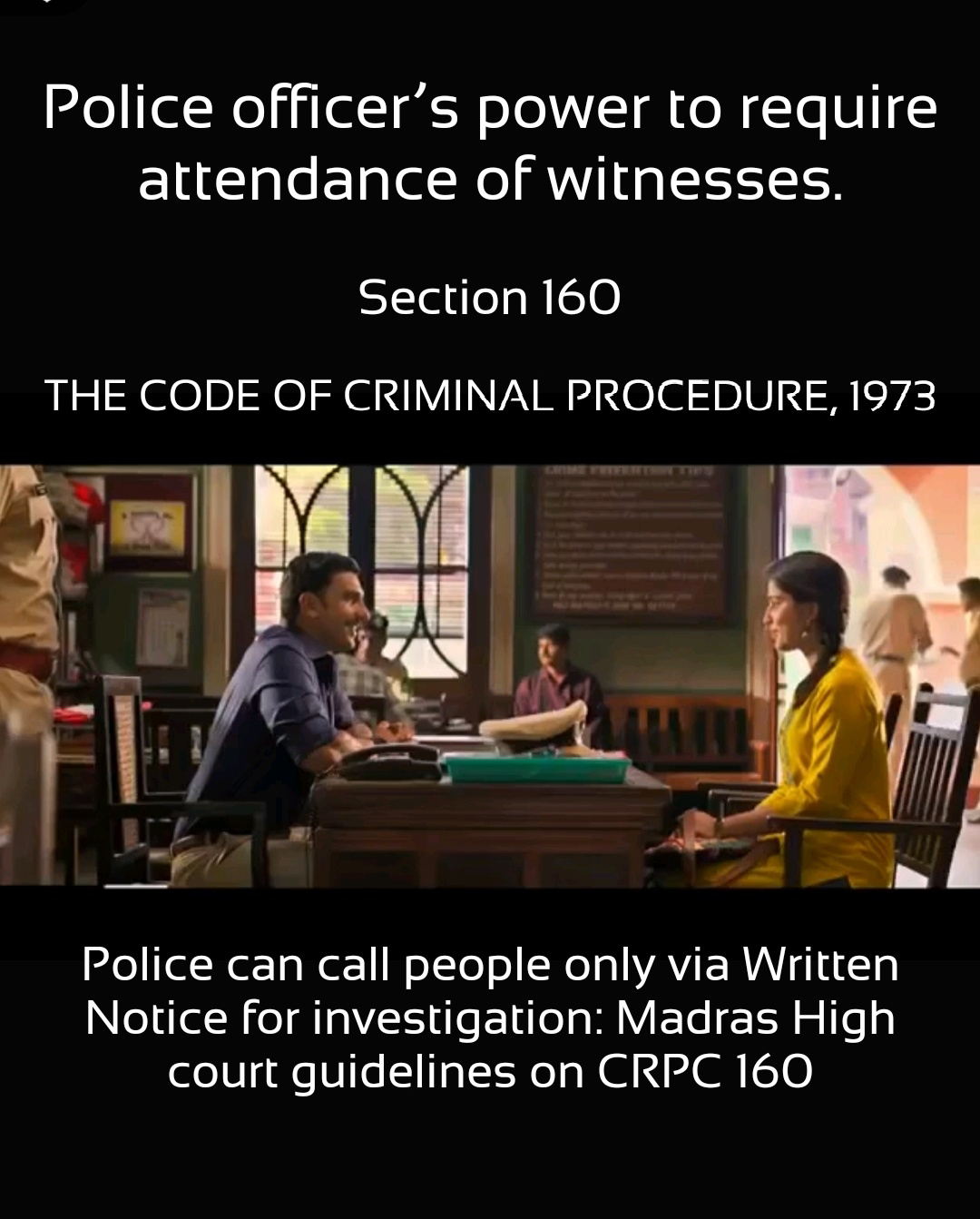
Police can call people only via written notice for investigation: Madras High court guidelines on CrPC 160

Image
#CRPC160 Police can call people only via written notice for investigation: Madras High court guidelines on CrPC 160. Someone from Police Station calls on your phone to ask to pay them a visit for enquiry/investigation/talk etc, is just plain illegal as far as adherence to CrPC is concerned.  The only legal way is via a written summons mentioning particular date and time (note: emails can also be taken as written notice). Police officer has to summon via a written summon, but that summon should also specify a particular date and time for appearing in front of police.   Also note that minutes of this enquiry have to be mandatorily noted in the general diary/station diary/daily diary of Police Station, which means again that the verbal chit-chat police people in Police Station like to engage with accused, without keeping written records, is also not legal.  All those probably happen with no entry about visit, or enquiry records anywhere. Any officer violatin...

Police Arrest Procedure & Your Rights

Image
In case of a Police Arrest Every Indian citizen must know the following GUIDELINES  LAID DOWN BY THE HON'BLE SUPREME COURT IN . D K BASU CASE The Hon'ble Supreme Court, in "D.K. Basu Vs State of West Bengal", has laid down  specific guidelines required to be followed while making an arrests, # The police personnel carrying out the arrest and handling the interrogation of the arrestee should bear accurate, visible and clear identification and name tags with their designations.  # The particular of all such personnel who handle interrogation of the arrestee must be recorded in a register. # That the police officer carrying out the arrest shall prepare a 'memo' of arrest at the time of arrest,  and  such memo shall be attested by at least one 'witness', who may be  either a member of the family of the arrestee OR a 'respectable person' of the locality from where the arrest is made. It shall also be counter signed by the arrestee and sh...

Key Legal contribution of Indian Freedom Fighter & Lawyer - 'Shri Vithalbhai Patel'

Image
Important Legal contribution of Indian Freedom Fighter & Lawyer - 'Shri Vithalbhai Patel' He passed and fought for several bills and amendments. Vithalbhai played a prominent role in two bills on the Bombay provincial legislative council, "the Bombay District Municipal Act Amendment Bill" and "The Town Planning Bill" in 1914.  His most well known proposal for which he received praise was for the extension of primary education to municipal districts in the Bombay presidency outside of the city of Bombay in 1917. After a long battle, the bill was passed after several amendments and modifications. Throughout his time on the legislative council, he passed and fought for several bills and amendments on medical practice.  In a 1912 amendment to the Bombay medical act, he sought to register doctors for disciplinary action for malpractice.  This amendment did not include ayurvedic physicians.  In 1923 he was elected to the Central Legislative Assembl...

Connect on Facebook