Posts

Dr. B. R. Ambedkar Quote

Image
#14thApril On The Birth Anniversary, Humble Tributes To Architect Of Indian Constitution, Dr. Babasaheb Ambedkar. #AmbedkarJayanti #WorldEqualityDay

Fundamental Rights in India

Image
'Fundamental Rights' are the basic human rights guaranteed by the Constitution of India.  The six fundamental rights include:  1) The Right to Equality (Article 14, 15, 16, 18) 2) Right to Freedom (Article 19, 20, 21, 21A, 22) 3) Right against Exploitation (Article 23, 24) 4) Right to Freedom of Religion (Article 25, 26, 27, 28) 5) Cultural and Educational Rights. (Article 29, 30) 5) Right to Constitutional Remedies. (Article 32)  The Constitution broadly provides for five kinds of "prerogative" Writs:  1) Habeas corpus,  2) Certiorari,  3) Mandamus,  4) Quo warranto and  5) Prohibition. Writ in India is the formal order of the court directing the authorities if there is a violation of the Fundamental Rights by a government authority or body.  You can file a writ petition in the Supreme Court under Article 32 of the Indian Constitution, whereas you can file the writ petition in High Court under Article 226 of the Indian constituti...

CrPC Section 133: Power to Remove Public Nuisance

Image
Section 133 to 143 of CRPC specifically deals with the Removal of any existing Nuisance in the Public place.  It is one of the most powerful tools in the hands of common public for removal of the danger arising or hanging on their heads, due to such nuisance. Lack of awareness about this law & its technicalities have resulted into less utilization of this powerful constitutional method for common benefit. Today we shall discuss the basic framework of this law. *** An application can be made under this section to a District Magistrate for the removal of a public nuisance.  Once application is received from the petitioner, magistrate orders a preliminary inquiry.  After satisfying himself with the initial material of the case through preliminary inquiry, and if required, after taking evidence on oath, magistrate issues an Order (an Order of Conditional in nature) (also known as Conditional Order) directing the opposite party to either remove such obstruction...

'Standing Committees' of Lok Sabha in India

Image
Twenty Four (24) 'Department Related Standing committees (DRSCs)' of Loksabha In 1993, in the history of Indian democracy a major initiative was taken in the direction of making the Parliament more effective in exercising control over and giving direction to the functioning Government (i.e.the executive) and thereby making the executive more accountable. Parliamentary Standing Committee means a Committee which is appointed or elected by the House or nominated by the Speaker and which works under the direction of the Speaker and presents its report to the House. Parliamentary Committees are of two kinds: Standing Committees and Ad hoc Committees. The Financial Committees, Department Related (DRSCs), and some other Committees come under the category of "Standing Committees".  "Ad hoc Committees" are appointed for a specific purpose and they cease to exist when they finish the task assigned to them and submit a report. *** Each Department Related St...

15 Animal Rights Every Animal Lovers in India Must Know

Image
1. Article 51 A (g): It is the fundamental right of every citizen of India to have compassion for all living creatures. 2. IPC Sections 428 and 429:  To kill or maim any animal, including stray animals is a punishable offence. 3. Section 11 (1)(i) and Section 11 (1)(j), Prevention of Cruelty to Animals Act, 1960: Abandoning any animal for any reason can land you in prison for up to three months. 4. Rule 3, Prevention of Cruelty to Animals (Slaughterhouse) Rules, 2001; Chapter 4, Food Safety and Standards Regulations, 2011: No animal (including chickens) can be slaughtered in any place other than a slaughterhouse. Sick or pregnant animals shall not be slaughtered. 5. ABC Rules, 2001: Stray dogs that have been operated for birth control cannot be captured or relocated by anybody including any authority. 6. Section 11 (1)(h), Prevention of Cruelty to Animals Act, 1960: Neglecting an animal by denying her sufficient food, water, shelter, and exercise or by keeping him chain...

Customer Protection – Limiting Liability of Customers in Unauthorised Electronic Banking Transactions

Image
Unauthorised or fraudulent electronic banking transaction in your account? Do not panic.  Follow the steps outlined by the RBI in the following notification. "Customer Protection – Limiting Liability of Customers in Unauthorised Electronic Banking Transactions" The Reserve bank of India (RBI) on 6th July 2017 amid the national drive toward digital transactions and rising incidents of fraud, had notified the norms in order to fix the liability in cases if a person loses money through an unauthorized electronic banking transaction like cyber attack on the bank or hacking of account. Read RBI notification here: DBR.No.Leg.BC.78/09.07.005/2017-18 https://www.google.com/url?sa=t&source=web&rct=j&url=https://rbidocs.rbi.org.in/rdocs/notification/PDFs/NOTI15D620D2C4D2CA4A33AABC928CA6204B19.PDF&ved=2ahUKEwjUk-OM0bDwAhVtzzgGHTjoAVEQFjADegQIFxAC&usg=AOvVaw088s3dB_PYeb4Ki8CujJ67&cshid=1620152507485 *** Disclaimer: These guides are not legal advice, no...

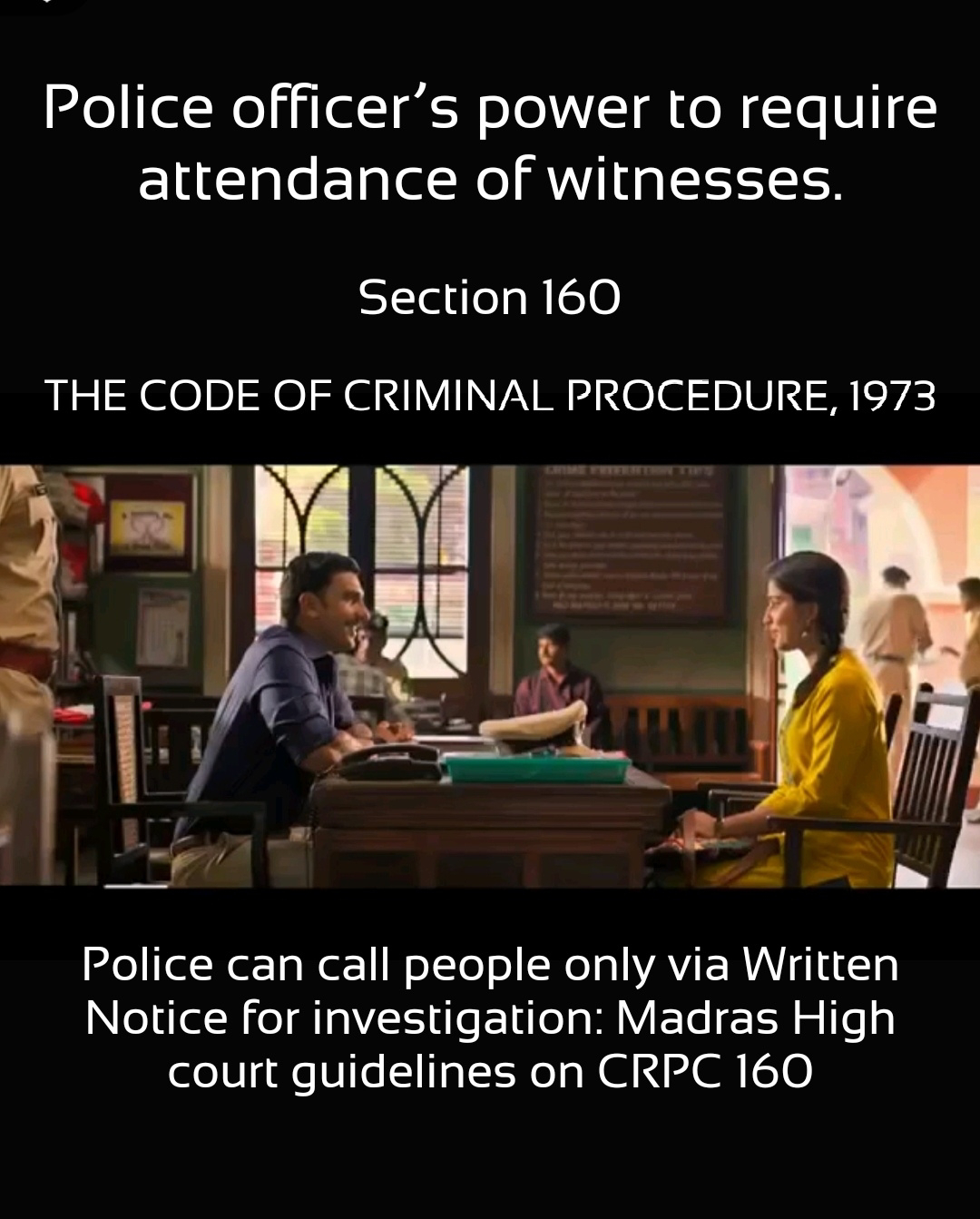
Police can call people only via written notice for investigation: Madras High court guidelines on CrPC 160

Image
#CRPC160 Police can call people only via written notice for investigation: Madras High court guidelines on CrPC 160. Someone from Police Station calls on your phone to ask to pay them a visit for enquiry/investigation/talk etc, is just plain illegal as far as adherence to CrPC is concerned.  The only legal way is via a written summons mentioning particular date and time (note: emails can also be taken as written notice). Police officer has to summon via a written summon, but that summon should also specify a particular date and time for appearing in front of police.   Also note that minutes of this enquiry have to be mandatorily noted in the general diary/station diary/daily diary of Police Station, which means again that the verbal chit-chat police people in Police Station like to engage with accused, without keeping written records, is also not legal.  All those probably happen with no entry about visit, or enquiry records anywhere. Any officer violatin...

Police Arrest Procedure & Your Rights

Image
In case of a Police Arrest Every Indian citizen must know the following GUIDELINES  LAID DOWN BY THE HON'BLE SUPREME COURT IN . D K BASU CASE The Hon'ble Supreme Court, in "D.K. Basu Vs State of West Bengal", has laid down  specific guidelines required to be followed while making an arrests, # The police personnel carrying out the arrest and handling the interrogation of the arrestee should bear accurate, visible and clear identification and name tags with their designations.  # The particular of all such personnel who handle interrogation of the arrestee must be recorded in a register. # That the police officer carrying out the arrest shall prepare a 'memo' of arrest at the time of arrest,  and  such memo shall be attested by at least one 'witness', who may be  either a member of the family of the arrestee OR a 'respectable person' of the locality from where the arrest is made. It shall also be counter signed by the arrestee and sh...

Key Legal contribution of Indian Freedom Fighter & Lawyer - 'Shri Vithalbhai Patel'

Image
Important Legal contribution of Indian Freedom Fighter & Lawyer - 'Shri Vithalbhai Patel' He passed and fought for several bills and amendments. Vithalbhai played a prominent role in two bills on the Bombay provincial legislative council, "the Bombay District Municipal Act Amendment Bill" and "The Town Planning Bill" in 1914.  His most well known proposal for which he received praise was for the extension of primary education to municipal districts in the Bombay presidency outside of the city of Bombay in 1917. After a long battle, the bill was passed after several amendments and modifications. Throughout his time on the legislative council, he passed and fought for several bills and amendments on medical practice.  In a 1912 amendment to the Bombay medical act, he sought to register doctors for disciplinary action for malpractice.  This amendment did not include ayurvedic physicians.  In 1923 he was elected to the Central Legislative Assembl...

Prevention of Cruelty to Animals Act, 1960

Image
Prevention of Cruelty to Animals Act, 1960 Question : Can people who feed animals in their areas be stopped by Resident welfare Association, societies, or neighbours under the law? Answer: Article 51 A of the Constitutional Law of India, speaks about the duties of every citizen of India one of these duties include having compassion for living creatures. So the animals are protected under the Constitution. Article 19 of Constitution of India, deals with the right to freedom of expression and in this freedom comes right to profession, occupation, trade and business. Therefore it means that every citizen has the right to occupation and if someone has taken the caring of animals as his occupation, it is legal and he has every right to carry on with his occupation. Article 21, of constitution of India states the right to personal life and liberty. If someone wants to feed and provide shelter to dogs, he is at liberty to do so. Section 503, of the IPC, 1860 provides that intimidation is crim...

Open burning of Garbage a major source of Air Pollution

Image
Air (Prevention and Control of Pollution) Act, 1981 Open burning of Garbage a major source of Air Pollution. In December 2016, The National Green Tribunal (NGT) ordered nationwide  ban on open burning of Garbage with penalty of upto Rs.25,000/- Disposal by burning of any type of solid waste at roadsides, or any private or public property is also prohibited as per BMC's Solid Waste Management Rules. Image Courtesy: TOI Source: https://m.timesofindia.com/city/mumbai/despite-ban-on-burning-waste-complaints-to-bmc-go-unheard/articleshow/80160632.cms

Consumer Cases on Banking

Consumer Cases on Banking The difference in the Interest paid to the 'Saving bank account' holder and the interest earned by the bank by lending his amount is the 'Consideration' for the Service of the bank.  It was held that a person holding a savings bank a/c with a bank would fall within the definition of consumer under the Consumer Protection Act Branch Manager, Canara Bank Vs. K.R. Hanumatha Rao - 1992(1) CPR 401 (SCRDC – Kar) The principles laid down by the various decisions of the Consumer Commissions and the Supreme Court and included in the compilation can be summarized as under: (i) Failure /Delay in repaying deposits Withholding of the amount due on a fixed deposit after its maturity, amounts to deficiency in service. Delayed payment of term deposits on maturity also amounts to deficiency in service. The principle applies to cases of inordinate delay in payment of proceeds of premature encashment of deposits as well. (ii) Payment and Collection of Cheques/Dra...

Even a weak man can rule a stronger with the help of the law...

"Even a weak man can rule a stronger with the help of the law..." Our ancient 'Upnishads' mention the importance of Law. 'Brihadaranyaka Upanishad' (1 of 13 famous Upnishads in India), mentions: "Law is the power of the kingdom, nor is there aught higher than the law. Even a weak man rules a stronger with the help of the law...". Our Honourable Prime Minister Shri Narendra Modi ji explains this very nicely. Source & Courtesy: PMO India PM Modi's speech on National Law Day 2017. https://youtu.be/c9miHn61hT4

Indian Penal Code - IPC166: Public servant disobeying law, with intent to cause injury to any person

Image
Indian Penal Code: IPC 166: Public servant disobeying law, with intent to cause injury to any person Whoever, being a public servant, knowingly disobeys any direction of the law as to the way in which he is to conduct himself as such public servant, intending to cause, or knowing it to be likely that he will, by such disobedience, cause injury to any person, shall be punished with simple imprisonment for a term which may extend to one year, or with fine, or with both. IIIustration: A, being an officer directed by law to take property in execution, in order to satisfy a decree pronounced in Z's favour by a Court of Justice, knowingly disobeys that direction of law, with the knowledge that he is likely thereby to cause injury to Z. A has committed the offence defined in this section. In a recent amendment in 2018, IPC 166A & IPC 166B, have been added to original IPC 166, It relates to non-registration of FIR & not following mandatory procedures in case...

Para from Dr. Ambedkar’s final speech in the Constituent Assembly, dated November 25, 1949

Dr. Bhimrao Ambedkar "We must hold on to constitutional methods of achieving our social and economic objectives.  It means we must abandon the bloody methods of revolution..  It means that we must abandon the method of civil disobedience, non- cooperation and satyagraha. Where constitutional methods are open, there can be no justification for these  unconstitutional methods. These methods are nothing but the Grammar of Anarchy and the sooner they are abandoned, the better for us."  -para from Dr. Ambedkar’s final speech in the Constituent Assembly, dated November 25, 1949. This independence day, let us take a pledge to use & explore various Constitutional methods to bring in the changes we want to see in our country. Source & Courtesy: Rajya Sabha Television https://youtu.be/9MYY4SXEGCE www.rstv.nic.in https://www.facebook.com/100430711450290/posts/185254199634607/?sfnsn=wiwspmo&extid=l9RcGRILvDcRBOCL&d=n&vh=e

The Consumer Protection Act, 2019

Image
New 'The Consumer Protection Act, 2019' has come into force from July 20, 2020. Replacing the old Consumer Protection Act 1986. New Act gives more power in the hands of Consumer. It helps consumer in seeking justice for the Deficiency in service, Unfair trade practice, Compensation for the loss/injury suffered due to sell of defective product/service [also known as Product Liability], Non refund/non-return of Product/Service by E-commerce seller within 30 days, misleading advertisement/endorsement, etc. The list is quite long. Did you know? You can personally file a complaint in Consumer court by just writing the complaint on a PLAIN PAPER. Why are Consumer Courts important? Not following the final order of the Consumer Courts can put the Seller (Opposite party) in Jail for the term from 1 month to 3 years and/Or fine from 25k to 1 lakh (*as per Section 72) Time limit for Courts to dispose of consumer complaint? Every Consumer Court must endeavour to dispose of the ...

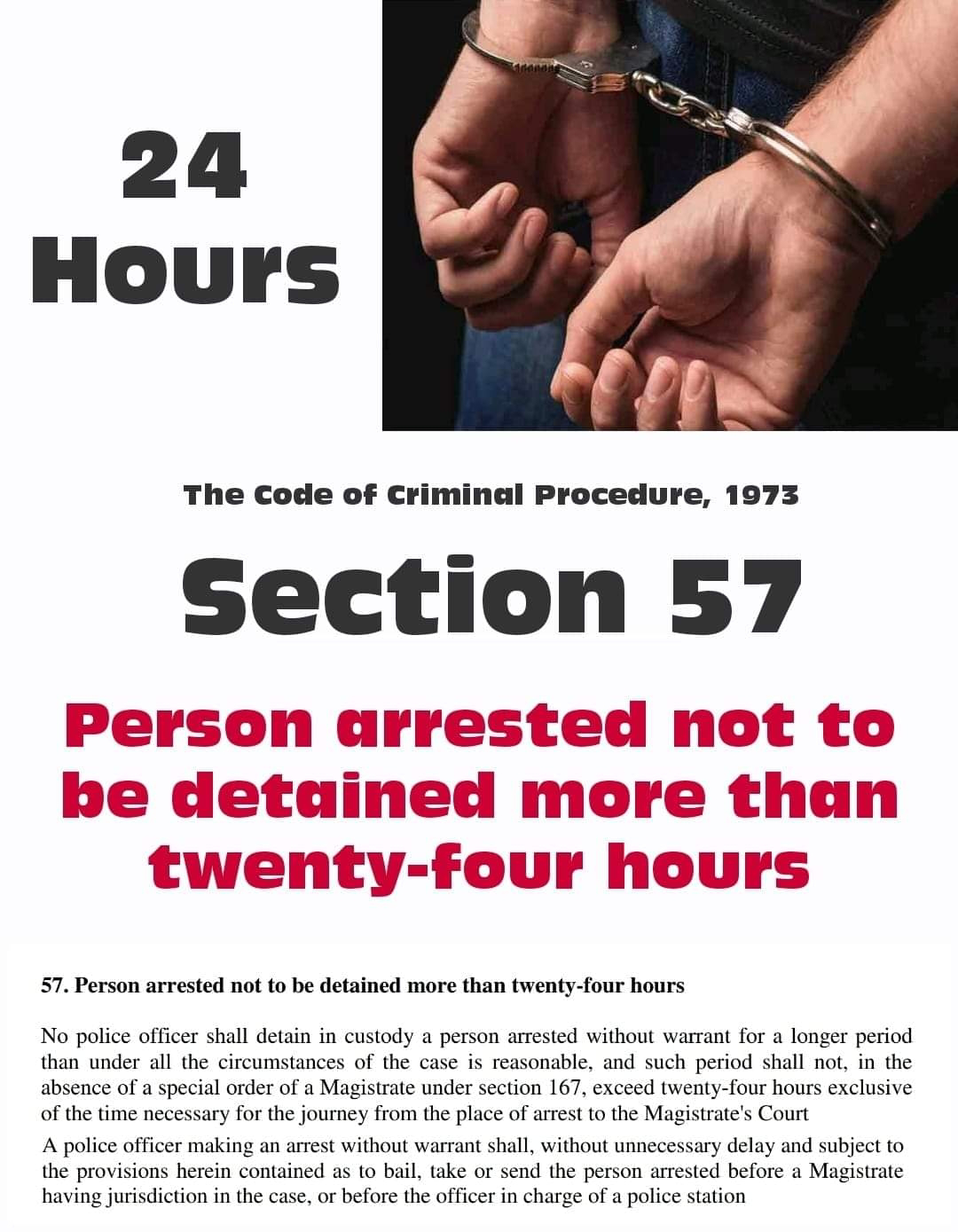
Police Arrest? Without warrant? How long can they keep you in initial custody in India? What is the procedure after arrest in India?

Image
*** Read Section 56 & 57 of "THE CODE OF CRIMINAL PROCEDURE, 1973" to understand better. Section 56: Person arrested to be taken before Magistrate or officer in charge of police station A police officer making an arrest without warrant shall, without unnecessary delay and subject to the provisions herein contained as to bail, take or send the person arrested before a Magistrate having jurisdiction in the case, or before the officer in charge of a police station Section 57: Person arrested not to be detained more than twenty-four hours No police officer shall detain in custody a person arrested without warrant for a longer period than under all the circumstances of the case is reasonable, and such period shall not, in the absence of a special order of a Magistrate under section 167, exceed twenty-four hours exclusive of the time necessary for the journey from the place of arrest to the Magistrate's Court. *** There are two types of offences: - Non...

Connect on Facebook